15 Math Activities for Preschoolers (Ages 2 to 5), Sorted by Age
 By the Math Learner team Updated 6 min read
Good preschool math activities are short (about 5 minutes), use things you already have, and build one skill at a time: counting objects one by one, recognizing numbers, comparing amounts, and spotting shapes and patterns.
You do not need worksheets or special toys to teach preschool math. The best activities take about 5 minutes, use things from your kitchen, and feel like play.
Below are 15 activities sorted by age, from toddlers to kindergarten. Each one tells you what you need, what to do, and the one skill it builds.
Why early math matters
Early math is more than a head start on numbers. In a large analysis of six long-term studies, published in 2007, math skills at school entry were the strongest predictor of later school achievement, ahead of early reading and attention skills. The data covered close to 36,000 children.
That does not mean preschoolers need drills. It means everyday talk about “how many”, “which is bigger” and “what comes next” is time well spent.
What math looks like at each age
Every child is different. Use this as a rough guide to pick activities, not as a checklist your child must pass.
| Age | What many children start to do |
|---|---|
| 2 to 3 | Use words like “more” and “big”. Say some number words, often out of order. Sort things by color. |
| 3 to 4 | Count a few objects one by one. Recognize some written numbers. Name circle, square and triangle. |
| 4 to 5 | Count larger groups. Know that the last number counted tells “how many”. Compare groups and continue simple patterns. |
| 5 to 6 | Count much further. In the US, kindergartners are expected to count to 100 by ones and by tens by the end of the year. Start adding and taking away small amounts. |
Activities for ages 2 to 3 (toddlers)
1. Count the stairs
- You need: stairs or steps.
- Do it: count out loud on every step, going up and down. Let your child join in when they can.
- Builds: hearing number words in order, linked to a real action.
2. Sort the socks
- You need: a pile of clean socks.
- Do it: sort them into piles by color. Then find the pairs.
- Builds: sorting and matching, early steps toward grouping and counting.
3. One for you, one for me
- You need: a few snacks or toys.
- Do it: share them out: “One for you, one for me.” At the end, ask “Is it fair? Do we have the same?”
- Builds: one-to-one matching and the idea of “the same”.
4. Big and small
- You need: pairs of things: a big spoon and a small spoon, a big ball and a small ball.
- Do it: ask your child to give you “the big one”, then “the small one”. Swap roles.
- Builds: comparing size, the start of measuring.
Activities for ages 3 to 4
5. Count and touch
- You need: 5 to 10 small objects.
- Do it: line them up. Count together, touching each object once. Ask “How many?” at the end.
- Builds: one-to-one counting, the most important early skill.
- What you will see when it clicks: your child stops skipping or double-counting objects, and answers “How many?” with the last number they said.
6. Number hunt
- You need: nothing (or a few numbers written on sticky notes).
- Do it: look for numbers in the shop, on doors and on buses. Or hide sticky notes with 1 to 5 around the house to find.
- Builds: recognizing written numbers. PBS KIDS for Parents suggests the same idea: spot numbers during everyday routines.
7. Pattern necklaces
- You need: pasta tubes or big beads and a string.
- Do it: start a pattern: red, blue, red, blue. Ask your child to continue it.
- Builds: spotting and continuing patterns.
- Harder: red, red, blue, red, red, blue.
8. Shape walk
- You need: a walk outside or around the house.
- Do it: find circles (clocks, plates), squares (windows, tiles) and triangles (roofs, sandwiches cut in half).
- Builds: shape names and noticing shapes in the real world.
9. Trace numbers in salt
- You need: a tray with a thin layer of salt, flour or sand.
- Do it: write a number with your finger. Your child traces it, then shakes the tray to erase it and tries alone.
- Builds: how numbers are written, using touch as well as sight.
Activities for ages 4 to 5 (and kindergarten)
10. Roll and count
- You need: one die and a pile of small objects.
- Do it: roll the die, say the number, and take that many objects. After 5 rolls, count all your objects. Biggest pile wins.
- Builds: matching a number to an amount, and counting bigger groups.
- Harder: use two dice and add them.
11. Number line hop
- You need: chalk outside, or paper numbers 0 to 10 on the floor.
- Do it: call a number and your child hops to it. Then: “Hop 2 more. Where are you now?”
- Builds: number order and the first idea of adding as moving forward.
12. How many more?
- You need: an egg carton (or any 10 spaces) and 10 small objects.
- Do it: put some objects in the carton. Ask “How many more to fill it?”
- Builds: the pairs that make 10 and early subtraction.
13. Measure with spoons
- You need: a spoon and some toys or books.
- Do it: measure things in spoons: “This book is 6 spoons long.” Which is longest?
- Builds: measuring and comparing length.
14. A simple board game
- You need: paper with a row of squares numbered 1 to 20, one die and two pieces.
- Do it: take turns rolling and moving, saying each number as you move.
- Builds: counting, number order and comparing which number is bigger. Numbered race games like this have good research behind them.
15. Grocery helper
- You need: a shopping trip.
- Do it: ask your child to put 4 apples in the bag, find the number 7 on a price tag, or check if you have more bananas or oranges.
- Builds: counting with a purpose, which is what makes math feel useful.
How to tell it is working
You will not see progress every day. Over a few weeks, look for these signs:
- Your child counts objects without skipping or counting one twice.
- They answer “How many?” with the last number they counted.
- They point out numbers they see in the street or shop.
- They notice when something is “not fair” or “more”.
- They start to count on their own during play.
If these come slowly, that is fine. Keep activities short and playful.
Using a math app at this age
Hands-on play should come first at this age. A good app can add some extra practice, especially for number writing.
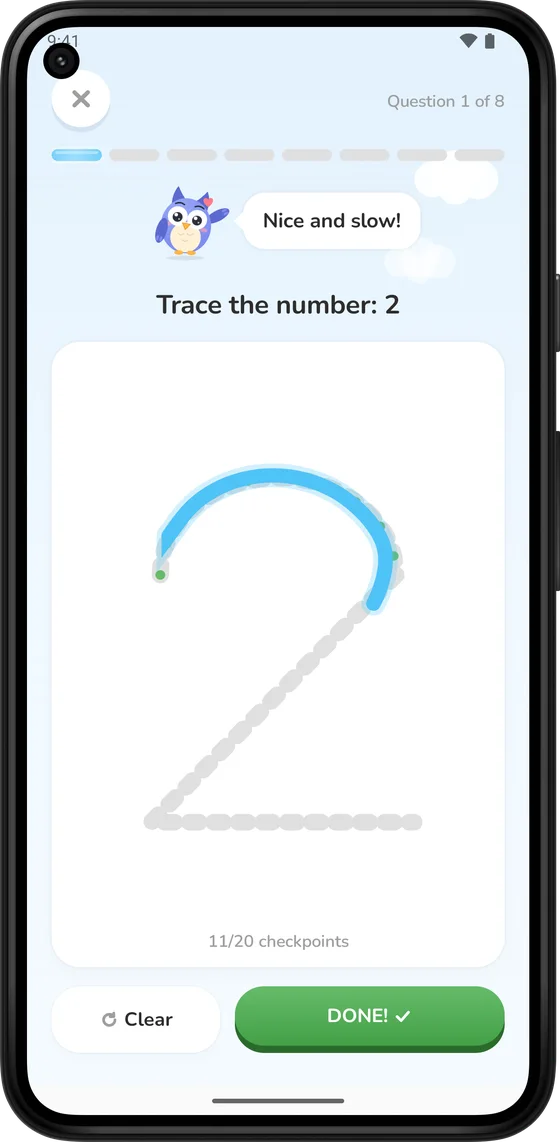
Our app, Math Learner, starts at age 3. The first worlds are about counting and tracing numbers with a finger, and a dot shows where each number starts. Rounds are short, there are no ads, and the first 15 levels of every world are free.
When your child is ready for more, see our 12 free math games for card and dice ideas. Later on, our guide on how to teach multiplication picks up where counting leaves off.
Questions parents ask
What math should a 4 year old know?
Many 4 year olds can count a small group of objects one by one, recognize some written numbers, say which group has more, and name simple shapes. Children develop at different speeds, so treat this as a rough guide, not a test.
How do I teach math to a 3 year old?
Through play and daily routines. Count stairs, toys and snacks together, touching each one as you count. Talk about big and small, more and less, and point out numbers you see outside.
How long should a preschool math activity be?
About 5 minutes is plenty for most preschoolers. Stop while your child is still having fun, and do it again another day.
At what age should kids start learning math?
Children start learning math ideas as toddlers, through play: more and less, big and small, counting songs. You do not need lessons. Everyday games and conversations are enough.
Is counting out loud the same as understanding numbers?
Not quite. Many young children can recite '1, 2, 3, 4, 5' before they can count 5 objects correctly. The key skill is one-to-one counting: one number for each object, and knowing the last number tells you how many.
Do I need to buy materials?
No. Spoons, socks, blocks, buttons, snacks, paper and a pen cover every activity in this guide.