12 Free Math Games for Kids, Sorted by Age (Most Need No Screen)
 By the Math Learner team Updated 6 min read
The best free math games for young kids are simple number board games, card games and dice games you can make at home. In studies, preschoolers who played a numbered board game for four short sessions got better at counting and comparing numbers.
You do not need an app or a subscription to make math fun. Most of the best math games for kids use things you already have: paper, a die, a deck of cards and a few snacks.
Below are 12 games sorted by age. Each one lists what you need, how to play and the skill it builds. Pick one and play it today.
Why games work for math
Games give kids a reason to count, compare and add, again and again, without it feeling like homework.
There is good research behind the simplest one, the number board game. In a study by Robert Siegler and Geetha Ramani, preschoolers from low-income families played a board game with squares numbered 1 to 10 in four sessions of about 15 minutes. Afterwards they were better at estimating where numbers go on a number line. Children who played the same game with colored squares instead of numbers did not improve.
A later study moved the game into Head Start classrooms, with small groups of 2 or 3 children. It improved number line estimation, comparing numbers, reading numerals and counting.
The key detail: kids say the numbers out loud as they move. That is what you are aiming for in every game below.
Ages 3 to 4: counting and “how many?”
1. Race to 10
- You need: paper, a pen, one die, two small toys as pieces.
- How to play: draw a row of 10 squares numbered 1 to 10. Take turns rolling and moving. Say each number as you land on it: “four, five, six”. First to 10 wins.
- Builds: counting, reading numbers 1 to 10, knowing that bigger numbers are further along.
- Easier / harder: use a die with only 1 and 2 on it (cover the other sides). Make it harder with 20 squares.
2. Counting treasure hunt
- You need: 10 small objects (blocks, buttons, toys).
- How to play: hide the objects around a room. Your child finds them, then lines them up and counts them, touching each one once.
- Builds: one-to-one counting (one number for each object), which is the base of all math.
- Easier / harder: hide 5. Or ask “How many more do we still need to find?”
3. More or less snack game
- You need: two plates and small snacks.
- How to play: put a few snacks on each plate. Ask “Which plate has more?” Your child guesses, then counts both to check. They eat the plate with less.
- Builds: comparing amounts and the words “more”, “less” and “the same”.
- Easier / harder: keep the difference big (2 and 7). Make it harder with close numbers (6 and 7).
4. Number spotting walk
- You need: nothing.
- How to play: on a walk or in a shop, spot numbers on doors, buses and price tags. Your child reads each one. Count how many you find.
- Builds: recognizing written numbers.
- Easier / harder: look only for one number (“find a 3”). Harder: read two-digit numbers.
Ages 5 to 6: counting on and adding
5. The 1 to 100 board game
- You need: a 10 × 10 grid on paper numbered 1 to 100, one die, two pieces.
- How to play: roll and move. The rule that matters: count on from the square you are on. If you are on 23 and roll 4, say “24, 25, 26, 27”, not “1, 2, 3, 4”.
- Builds: counting on, the number order to 100 and early addition.
- Why that rule: in one study, kindergartners who counted on from their square learned more than kids who counted “1, 2, 3, 4”.
6. Card War
- You need: a deck of cards with the picture cards removed (Ace = 1).
- How to play: split the deck. Each player turns over one card. The bigger number wins both cards. Equal cards mean “war”: each puts down another card.
- Builds: comparing numbers quickly.
- Harder: each player turns two cards and adds them. The bigger total wins.
7. Make 10
- You need: cards 1 to 9 from a deck.
- How to play: lay 12 cards face up. Take turns finding two cards that add up to 10 (like 3 and 7). Keep the pairs. Refill the gaps.
- Builds: the pairs that make 10, which make later adding and subtracting much easier.
- Easier: play “Make 5” with cards 1 to 4.
8. Roll and add
- You need: two dice, paper.
- How to play: roll both dice and add them. Write the total. After 10 rolls, the player with the biggest sum of totals wins.
- Builds: adding small numbers, and in time, knowing dice totals by sight.
- Harder: subtract the smaller die from the bigger one instead.
Ages 7 to 10: times tables, money and strategy
9. Multiplication War
- You need: a deck of cards, picture cards removed.
- How to play: each player turns over two cards and multiplies them. The bigger answer wins all four cards.
- Builds: times table recall under friendly pressure.
- Easier: use only cards 1 to 5. Pair this with our guide to teaching multiplication.
10. Dice products race
- You need: two dice, and for each player a 6 × 6 times table grid (the 1 to 6 tables written out).
- How to play: roll two dice and multiply. Cross out one square with that answer on your grid. First to cross out a full row wins.
- Builds: facts up to 6 × 6, and noticing that some answers (like 12) come up much more often than others.
11. Shop game
- You need: real coins, toys with price tags you write.
- How to play: one player is the shopkeeper. The other buys items and pays. The shopkeeper gives change.
- Builds: coin values, adding money and subtracting for change.
- Harder: give a budget: “You have 2 dollars. What can you buy?”
12. Target number
- You need: cards 1 to 10.
- How to play: turn over 4 cards and pick a target number, like 24. Use any of +, −, × and ÷ with the 4 cards to reach it. Everyone tries, then shares their way.
- Builds: flexible thinking and all four operations.
- Easier: use 3 cards and only + and −.
Store-bought board games that teach math
If you want a ready-made game, these are popular with families. The ages are what the maker or major retailers list, so check the box before you buy.
| Game | Main skill | Listed age |
|---|---|---|
| Sum Swamp | Adding and subtracting | Usually 5 and up |
| Money Bags | Coin values and counting money | Usually 7 and up |
| Prime Climb | Multiplying, dividing, primes | 10 and up (8 and up with an adult, says the maker) |
Classic games help too. Any race game with numbered squares works if your child says the numbers out loud.
Free math apps: is “free” really free?
Many “free” math games online and in app stores make money another way. Before you install one, check:
- Ads: does the store listing say “Contains ads”? Ads can pull kids out of the game.
- In-app purchases: is only part of the game free?
- Data: does it ask for an account or personal details?
Our guide to the best math apps for kids compares the main apps on exactly these points.
Our pick for screen time
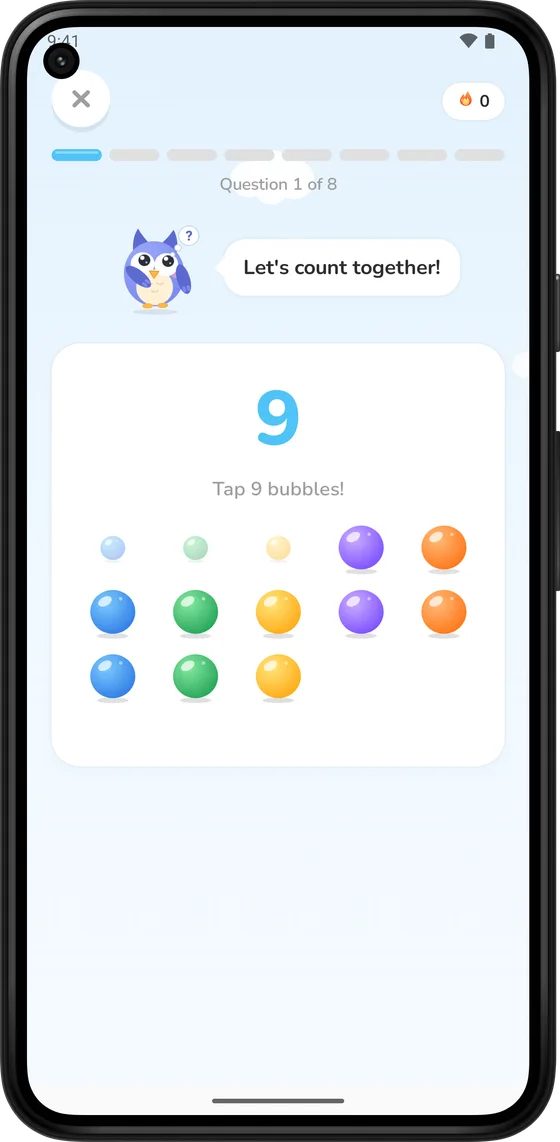
We make Math Learner, so we are biased, but it was built to match the games above. Kids aged 3 to 10 work through six worlds: counting, number tracing, addition, subtraction, multiplication and division. There are no ads and no account. The first 15 levels of every world are free, with one lesson a day. Math Learner Premium is an optional subscription for the rest.
Still, start with the free games on this page. A deck of cards and 10 minutes with you is hard to beat.
Questions parents ask
Are there free math games with no ads?
Yes. Every game in this list is free and needs no screen, so there are no ads at all. For apps, check the store listing for ads and in-app purchases before you install.
What are good math games for kindergarten?
Try a 1 to 100 board game where your child counts on from their square, card War with numbers up to 10, and Make 10 with playing cards. All three build counting and number sense.
What math games can we play without a screen?
Board games with numbered squares, dice games, card games like War, shop games with real coins and counting hunts around the house all work well and cost nothing.
Do board games really help with math?
Research suggests they can. In studies by Siegler and Ramani, preschoolers who played a numbered board game in a few short sessions improved at counting, reading numbers and comparing amounts. A version with colors instead of numbers did not help.
Can Chutes and Ladders help my child learn to count?
Any game with numbered squares in a row can help, as long as your child says the numbers out loud while moving. Saying 'six, seven, eight' is what builds the skill.
At what age can kids start playing math games?
Simple counting games work from about age 3. Start with numbers up to 10, use one die, and keep games short.
Sources
- Siegler and Ramani (2008). Playing linear numerical board games promotes low-income children's numerical development. Developmental Science.
- Ramani, Siegler and Hitti (2012). Taking it to the classroom: Number board games as a small group learning activity. Journal of Educational Psychology.
- Laski and Siegler (2013). Learning from number board games: You learn what you encode. Developmental Psychology.
- Math for Love: Prime Climb