How to Teach Multiplication: A Simple 4-Stage Plan for Parents
 By the Math Learner team Updated 7 min read
Start by showing what multiplication means with equal groups and arrays. Then learn the easy tables first (1, 10, 2, 5), practice answering from memory for about 5 minutes a day, and finally connect it to division. In the US, kids are expected to know every fact up to 9 × 9 from memory by the end of 3rd grade.
Times tables feel like a wall to many kids. Facing 100 facts at once, they freeze. The good news: there are far fewer facts to learn than it looks, and a clear order makes each step small.
This plan has four stages. Many children aged 7 to 9 move through them in a few months with about 5 minutes of practice a day.
When do kids learn multiplication?
Most children start between 7 and 8. In the US, the Common Core standards build arrays and repeated addition in 2nd grade. Multiplication itself is a 3rd grade topic, and the goal for the end of that year is clear: know from memory all products of two one-digit numbers.
Other countries use different ages and grade names, but the order of skills is similar everywhere: understand it first, then memorize it.
Stage 1: Show what multiplication means
Before any memorizing, your child should know what “3 × 4” means. It means 3 groups of 4. A child who understands this can always rebuild a fact they forget.
Make equal groups with things at home
Use snacks, toy cars, coins or socks.
- Put 4 crackers on each of 3 plates.
- Ask: “How many plates? How many on each plate? How many in all?”
- Write it down together: 3 × 4 = 12.
Do this with different numbers for a few days. Let your child make the groups and say the sentence: “3 groups of 4 is 12.”
Build arrays and spot the swap
An array is the same groups placed in neat rows. Lay out 3 rows of 4 buttons. Now turn the paper sideways: it is 4 rows of 3, and still 12 buttons.
This is the most useful trick in the whole plan. Because 3 × 4 = 4 × 3, every fact your child learns is really two facts. The 100 facts in a 10 × 10 table shrink to just 55 different ones.
Ready for stage 2 when your child can show any small multiplication with objects and explain it in their own words.
Times table drill
Pick a table, then answer 10 quick questions. Pip will cheer you on.

Pick a table and let's go!
Choose a table
Stage 2: Learn the tables in the easy order
Do not go 1, 2, 3, 4 in order. Start with the tables that have a pattern your child can see. Each new table then reuses facts they already know.
| Order | Table | The trick |
|---|---|---|
| 1 | × 1 | Any number times 1 stays the same. |
| 2 | × 10 | Add a 0 to the end: 10 × 7 = 70. |
| 3 | × 2 | It is doubling: 2 × 8 = 8 + 8. |
| 4 | × 5 | Half of the 10 times: 5 × 8 is half of 80. Answers end in 0 or 5. |
| 5 | × 11 | Up to 9, repeat the digit: 11 × 6 = 66. |
| 6 | × 4 | Double, then double again: 4 × 7 = 14, then 28. |
| 7 | × 3 | The 2 times plus one more group: 3 × 6 = 12 + 6. |
| 8 | × 9 | The 10 times minus one group: 9 × 6 = 60 − 6. |
| 9 | × 6 | The 5 times plus one more group: 6 × 7 = 35 + 7. |
| 10 | × 8 | Double three times: 8 × 3 = 6, 12, 24. |
| 11 | × 7 | Only 7 × 7 = 49 is new. The rest are known from earlier tables. |
| 12 | × 12 | The 10 times plus the 2 times: 12 × 4 = 40 + 8. |
Look at what happens to the 7 times, the table kids fear most. By the time you get there, your child already knows 7 × 2, 7 × 3, 7 × 4, 7 × 5, 7 × 6, 7 × 8 and 7 × 9 from the other tables. Only 7 × 7 is left.
The finger trick for the 9 times
Hold up 10 fingers. For 9 × 4, fold down the 4th finger. There are 3 fingers to the left of it and 6 to the right: 36. It works for every fact up to 9 × 10, and kids love it.
Another check: the digits in any answer up to 9 × 10 add up to 9 (3 + 6 = 9).
Ready for the next table when your child can explain the trick and work out any fact in that table without counting on their fingers one by one.
Stage 3: Practice recall, 5 minutes a day
Knowing how to work out 6 × 7 is not the same as just knowing it. To be quick, your child needs to pull facts from memory. This is where short, regular practice matters.
Why answering from memory beats chanting
Chanting “one seven is seven, two sevens are fourteen” feels productive, but your child never has to find an answer on their own.
In a 2023 study with 48 second graders, one group practiced the 3 and 4 tables with flashcards, answering each fact from memory. Another group chanted the same facts aloud. The flashcard group became faster and more accurate, and they kept that lead a week later. It was one small study on two tables, but it matches what teachers see: kids learn facts by recalling them, not by hearing them.
Practical ways to do this:
- Flashcards: question on the front, answer on the back. Make two piles: “knew it” and “not yet”. Repeat the “not yet” pile.
- Quick-fire questions in the car or at dinner: “What is 6 × 4?”
- Cover-up: write the table, cover one answer with a coin, and ask for it.
- Games: card and dice games turn practice into play. See our free math games for kids for ideas that need no screen.
- Printables: put a free printable multiplication chart on the wall, or make a multiplication worksheet with the tables your child is learning and an answer key.
A one-week practice plan
Five minutes a day is enough. Stop while it is still fun.
| Day | What to do (about 5 minutes) |
|---|---|
| Monday | Introduce the new table with its trick. Build two of its facts with objects. |
| Tuesday | Flashcards for the new table only. Sort into “knew it” and “not yet”. |
| Wednesday | “Not yet” pile first, then the full new table in random order. |
| Thursday | Mix the new table with 5 facts from older tables. |
| Friday | Play a game using the new table. |
| Weekend | A few quick-fire questions, just for fun. |
When most cards go straight into the “knew it” pile, move on.
Apps for extra practice
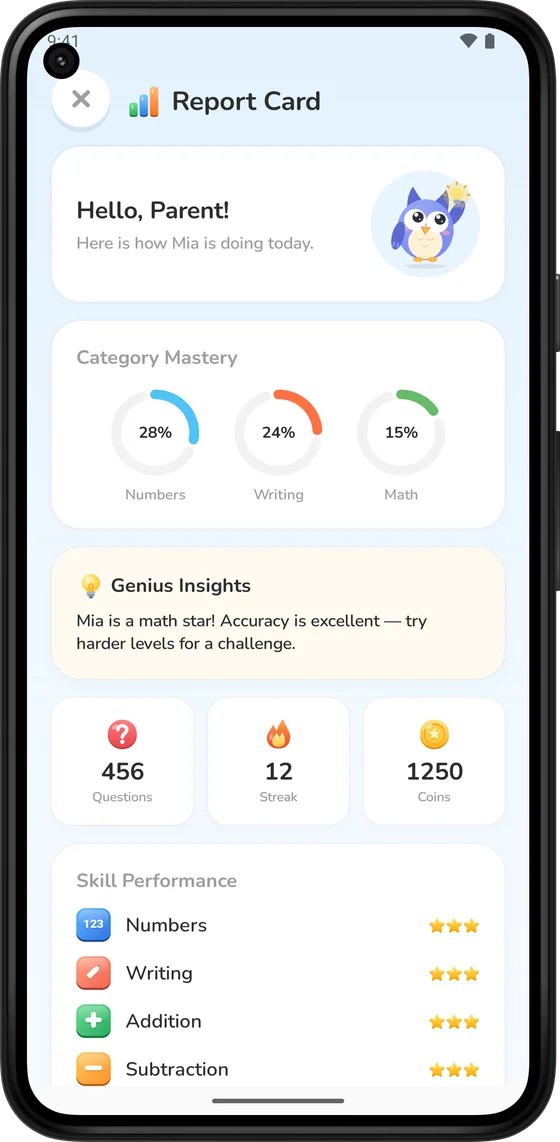
If your child enjoys a screen, an app can take over some of the practice. Our app, Math Learner, has a Multiplication world that teaches the tables in small steps across 50 levels. A wrong answer shows the right one, so kids learn from mistakes instead of getting stuck, and the Report Card shows parents how each topic is going. The first 15 levels of every world are free.
Use any app as a top-up to the stages above, not a replacement for them. Our guide to the best math apps for kids compares the main options.
Stage 4: Link it to division and real problems
Once a table is solid, show your child that every multiplication fact hides a division fact. If 3 × 4 = 12, then 12 ÷ 4 = 3 and 12 ÷ 3 = 4.
Go back to the crackers: 12 crackers shared on 3 plates gives 4 on each plate. It is the same picture, just backwards.
Then use facts in everyday life:
- “Each pack has 6 yogurts. We have 3 packs. How many yogurts?”
- “Tickets cost 5 dollars each. How much for 4 people?”
- “We have 20 strawberries for 4 people. How many each?”
Word problems like these show that the tables are useful, which is often what keeps a child going.
Is my child ready for the next table?
Use this quick check before moving on:
- They can explain what the fact means (“6 groups of 7”).
- They can use the trick for that table.
- They answer most facts in about 3 seconds, without counting one by one.
- They still know the facts from older tables when mixed in.
If two or more of these are shaky, stay on the same table another week. That is normal.
When your child gets stuck or upset
Most kids hit a hard week. Some things that help:
- Shrink the task. Practice 3 facts, not 10.
- Go back a stage. If 6 × 7 will not stick, build it with objects again. Understanding often helps the fact stick.
- Show progress. A chart of known facts that slowly fills up is very motivating.
- Drop the timer if it causes stress. Speed comes after confidence.
- Talk to the teacher if your child also finds counting, comparing numbers or small sums very hard. Teachers see many children and can tell you if more support makes sense.
Times tables take time for nearly every child. A calm 5 minutes a day will get you further than a long, tense hour on Sunday.
Questions parents ask
What age do kids learn multiplication?
Most kids start around age 7 or 8. In the US, the Common Core standards build arrays and repeated addition in 2nd grade, then teach multiplication in 3rd grade and expect kids to know all products of two one-digit numbers from memory by the end of that year.
Should my child understand multiplication before memorizing the tables?
Yes. A child who knows that 3 × 4 means 3 groups of 4 can work out a fact they forget. Spend a week or two on equal groups and arrays before you start memorizing.
Which times table should we learn first?
Start with the tables that have a clear pattern: 1, 10, 2 and 5. Then 11, 4, 3 and 9. Save 6, 8, 7 and 12 for last, because by then most of their facts are already known from earlier tables.
How long does it take to learn the times tables?
It depends on the child. Many kids learn one new table every week or two with short daily practice. Going slower is fine. Moving on before a table is solid usually costs more time later.
My child forgets the facts the next day. What helps?
Short, regular recall practice works better than long sessions. Mix in a few old facts every day, so earlier tables stay fresh, and keep each session to about 5 minutes.
Do songs and chanting work?
Songs can make the tables familiar, but answering from memory seems to work better. In a 2023 study, second graders who practiced with flashcards did better than those who chanted the same facts aloud.
Could trouble with times tables be a sign of a learning difficulty?
Many kids find the tables hard, so struggling is not a sign on its own. If your child also has trouble with counting, comparing numbers or small sums, talk to their teacher about it.
Sources
- Common Core State Standards, Grade 3 Operations and Algebraic Thinking (3.OA.C.7)
- Ophuis-Cox, Catrysse and Camp (2023). The effect of retrieval practice on fluently retrieving multiplication facts. Applied Cognitive Psychology.
- The Hechinger Report: Flashcards prevail over repetition in memorizing multiplication tables