Best Math Apps for Kids (Ages 3 to 10): An Honest Parent's Guide
 By the Math Learner team Updated 6 min read
For a free app with no ads, Khan Academy Kids (ages 2 to 8) is hard to beat. For a math-only app from age 3 to 10 with no ads, try Math Learner. For older kids, Prodigy Math (grades 1 to 8) and DragonBox Multiplication (ages 8 and up) are strong picks. Whatever you choose, check for ads, the real price and whether your child is actively thinking, not just tapping.
A quick note before we start: we make Math Learner, and it is in this list. To keep things fair, we judged every app, including ours, with the same checklist, and we only list facts we could confirm on each app’s own website or store page. Last checked: October 2026.
How we judged the apps
There is no official rating for educational apps, so we used two trusted sources.
1. The four pillars of learning. In a 2015 review of the research, psychologists Kathy Hirsh-Pasek and colleagues say children learn best when they are:
- actively involved: thinking and choosing, not just tapping,
- engaged: focused on the learning, not distracted by extras,
- making meaning: connecting it to things they know,
- socially interactive: talking about it with others.
2. Pediatric advice on media. The American Academy of Pediatrics suggests families pick apps that teach and avoid content with lots of ads.
From those, we checked each app for:
- Age fit: does it match the age your child is now?
- Ads: are there ads that can pull a child out of the app?
- Clear price: what is free, and what costs money?
- Privacy: does it need an account or collect personal data?
Quick comparison
| App | Ages | Math covered | Price model | Ads |
|---|---|---|---|---|
| Khan Academy Kids | 2 to 8 | Math plus reading and more | Free | None (stated by the app) |
| Math Learner | 3 to 10 | Counting to division | Free start, optional subscription | None |
| Moose Math | 3 to 7 (App Store) | Early math | Free | None (App Store listing) |
| DragonBox Numbers | 4 to 8 | Numbers to 100 | Part of a Kahoot!+ subscription | Check listing |
| DragonBox Multiplication | 8 and up | Times tables | Part of a Kahoot!+ subscription | Check listing |
| SplashLearn | Preschool to grade 5 | Math and reading | Check current plans | Check listing |
| Prodigy Math | Grades 1 to 8 | Grade-level math in a game | Free to play, optional membership | Check listing |
“Check listing” means we could not confirm it on the official page. Look at the store listing before you install.
The apps, one by one
Khan Academy Kids: best free all-rounder
Khan Academy Kids is for ages 2 to 8 and covers math alongside reading and other early skills. Its App Store page says it is “100% free” with no ads and no subscriptions. It is also on Google Play and the Amazon Appstore.
- Best for: families who want one free app for many early subjects.
- Know this: math is one part of a bigger app, so there is less depth for older kids who need times tables practice.
Math Learner: best math-only app from 3 to 10 with no ads
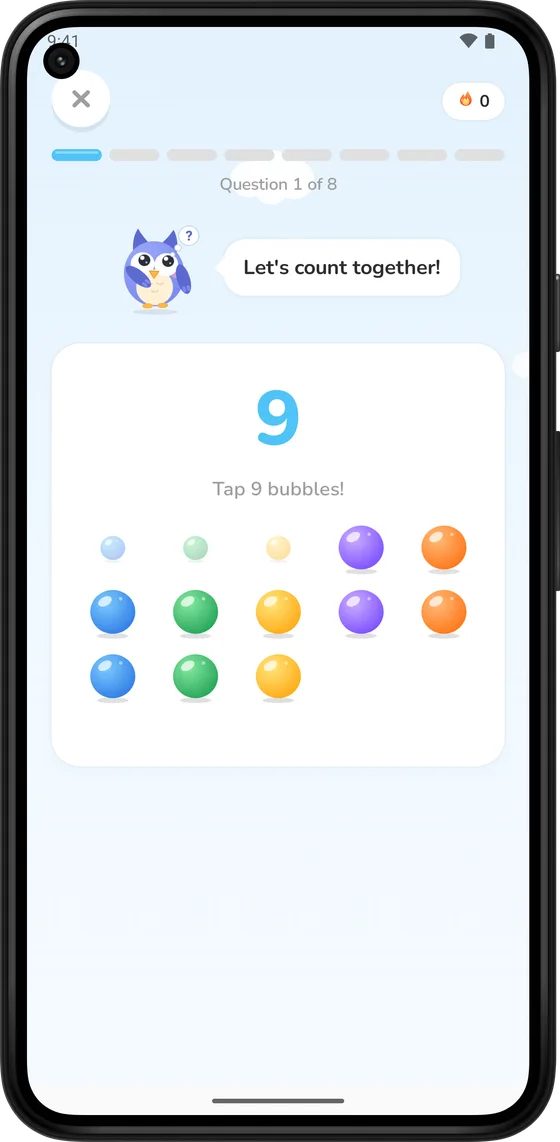
This is our app. Math Learner covers the full path from counting to division in six worlds: Numbers, Writing (tracing numbers with a finger), Addition, Subtraction, Multiplication and Division. Each world has 50 short levels with Pip the owl, and a Report Card shows parents how each topic is going.
- Best for: kids aged 3 to 10 who need math practice in their own language. It has 33 languages, including Spanish, Hindi, Arabic and Chinese.
- Privacy: no ads, no account and no tracking. Progress is saved on the device.
- Know this: the free plan is the first 15 levels of every world, one lesson a day. Math Learner Premium is a subscription that adds unlimited lessons, all 50 levels and a bonus world. It is a math-only app, so it does not teach reading.
Moose Math: a free start for little ones
Moose Math comes from Duck Duck Moose, part of Khan Academy. Its App Store listing gives ages 3 to 7 and says it is free.
- Best for: preschoolers taking their first steps in counting.
- Know this: it is aimed at young children, so older kids will outgrow it.
DragonBox Numbers and DragonBox Multiplication
The DragonBox apps are now part of Kahoot!. According to Kahoot!, DragonBox Numbers is recommended for ages 4 to 8 and DragonBox Multiplication for ages 8 and up. Both come with a Kahoot!+ subscription.
- Best for: kids who like puzzle-style games that build number sense in an unusual, visual way.
- Know this: you pay through a Kahoot!+ subscription, not a one-off purchase.
SplashLearn: math and reading by grade
SplashLearn covers preschool (ages 2 to 5) up to grade 5, in math and reading. It works on the web and on iOS and Android.
- Best for: families who want lessons that follow school grades.
- Know this: we could not confirm current prices on its site, so check the plans before you subscribe.
Prodigy Math: a fantasy game for older kids
Prodigy Math covers grades 1 to 8. Kids answer math questions to progress in a fantasy adventure. According to Prodigy, the math questions are free. An optional membership adds extras like goal setting, practice sheets and in-game items.
- Best for: kids aged about 7 and up who love role-playing games.
- Know this: the game world is a big part of the fun, so check that your child is answering questions, not only exploring.
Free vs paid: what “free” usually means
“Free” can mean very different things:
- Fully free: everything is free with no ads (Khan Academy Kids says it works this way).
- Free with ads: you pay with your child’s attention. Ads can lead kids out of the app.
- Free start: some content is free and the rest needs a subscription (Math Learner and Prodigy work this way).
- Free trial: everything is open for a short time, then you pay.
None of these is wrong. Just know which one you are getting before your child gets attached to an app.
How much screen time is OK?
There is no single right number for every family. The American Academy of Pediatrics suggests making a family media plan: choose quality apps, keep some times and places screen-free (like meals and bedtime), and use media together when you can.
A good math app works best as a short, regular top-up. Pair it with hands-on play. Our 12 free math games for kids need only cards, dice and paper, and our preschool math activities take 5 minutes each.
Our advice
- Ages 2 to 5: start free with Khan Academy Kids or Moose Math, or try Math Learner’s free levels for counting and number tracing.
- Ages 5 to 7: pick an app that covers adding and subtracting with short rounds, and check the ads policy.
- Ages 7 to 10: times tables need regular recall practice. Math Learner’s Multiplication world, DragonBox Multiplication and Prodigy all help. Our guide on how to teach multiplication shows how to combine an app with offline practice.
Whatever you choose, sit with your child for the first few sessions. You will learn more about whether an app teaches from 10 minutes of watching than from any review, including this one.
Questions parents ask
What is the best math app for preschoolers?
For ages 3 to 5, look for apps built around counting and number recognition with short rounds. Khan Academy Kids (ages 2 to 8), Moose Math (listed for ages 3 to 7) and Math Learner (from age 3) all start at this level.
Are there free math apps with no ads?
Yes. Khan Academy Kids says it is free with no ads and no subscriptions. Math Learner has no ads and lets kids play the first 15 levels of every world for free.
Do math apps work offline?
Some do and some do not. Apps that save progress on the device usually work without internet once installed, while web-based platforms need a connection. Check the app's store page or test it in airplane mode.
Are math apps safe for kids?
Check three things: whether it shows ads, whether it needs an account, and what data it collects. The store listing shows a privacy summary, and the app's privacy policy gives details.
Are paid math apps worth it?
Sometimes. A paid plan can add more levels or remove limits. Try the free part first for a week. If your child keeps asking to play and you can see progress, paying may be worth it.
How can I tell if an app really teaches?
Researchers suggest four signs: the child is actively thinking, stays engaged with the learning (not distracted by extras), the content connects to real life, and there is room to talk about it with others.
Sources
- Hirsh-Pasek et al. (2015). Putting Education in 'Educational' Apps: Lessons From the Science of Learning. Psychological Science in the Public Interest 16(1).
- HealthyChildren.org (American Academy of Pediatrics): How to Make a Family Media Use Plan
- Khan Academy Kids on the App Store
- Kahoot! learning apps (DragonBox Numbers and Multiplication)
- Prodigy for parents
- SplashLearn